|
Click to listen to this article
|
Story and photos by Denise Keller, Editor
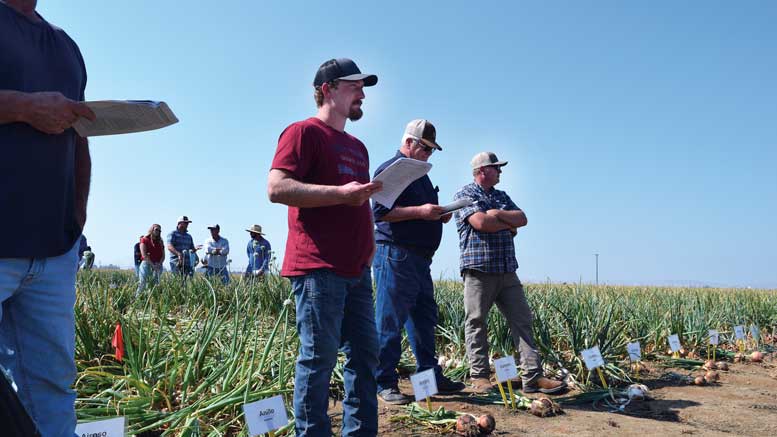
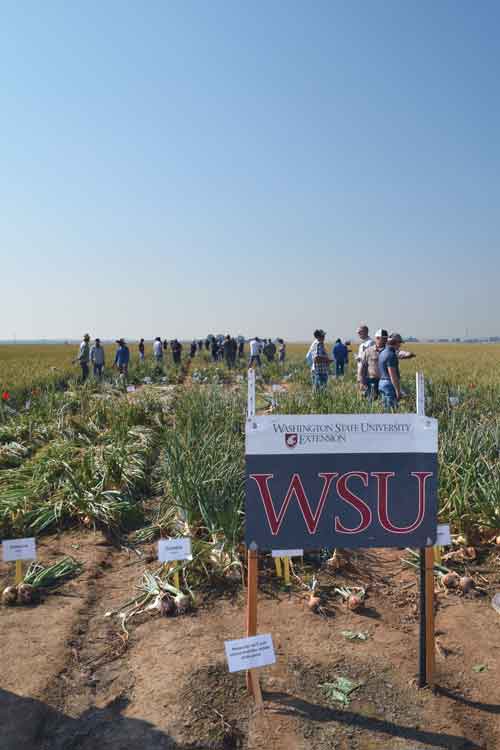
Toward the end of July this year, Washington State University (WSU) plant pathologist Lindsey du Toit began hearing from onion growers reporting powdery mildew in their Columbia Basin onion fields. By the time the annual WSU Onion Field Day rolled around on Aug. 28, powdery mildew incidence in the Columbia Basin was the highest du Toit has seen in her 25 years of working with onions in the region. At the field day, she took the opportunity to educate attendees about powdery mildew development, symptoms and management.
Disease Development
Powdery mildew, a disease favored by high relative humidity, is typically unproblematic in the Columbia Basin because of the region’s low humidity and infrequent rainfalls. However, weather this summer was unusual, including a milder July followed by a warmer August. Warm days alternating with cool nights in late summer, combined with a dense crop canopy, can result in higher relative humidity, driving the disease.
“There’s a huge benefit to growers in the western U.S. where you have the ability to control the moisture with irrigation, when it goes on and how much goes on,” du Toit said. “When we have humidity like this, you start to get a little taste of what East Coast and Midwest growers have to deal with in terms of disease pressure.”
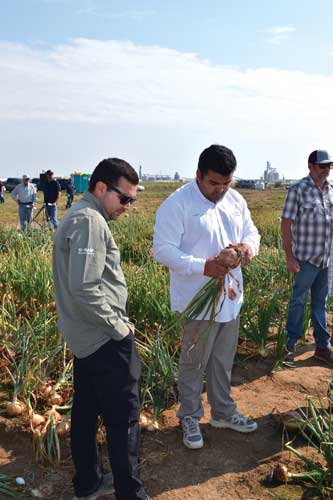
du Toit discussed factors that can further impact onions’ susceptibility to powdery mildew including method of irrigation. The disease is typically more severe in drip-irrigated and furrow-irrigated fields and is seldom seen in overhead-irrigated onions because powdery mildew fungi are not favored by “free moisture” on the leaves, only by high humidity.
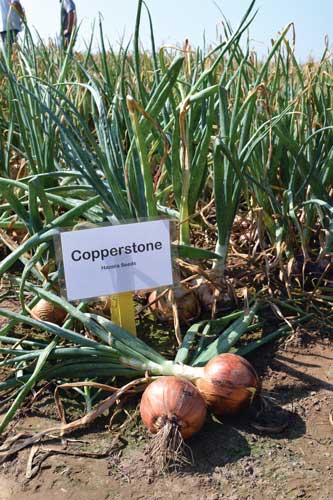
Susceptibility varies widely among onion cultivars. However, glossy-type varieties tend to be more susceptible because they have less epicuticular wax on their leaves. Similarly, regularly treating onions with insecticides and adjuvants that remove some of the waxes from onion leaves can make plants more susceptible to infection. du Toit mentioned a 2006 drip-irrigated onion trial evaluating thrips insecticides, in which every plot treated with insecticide developed powdery mildew whereas all of the non-treated plots did not.
“It was a real wakeup call about the extent to which some of our insecticide applications are stripping waxes off the leaves, increasing the risk of diseases like powdery mildew. I’m not saying don’t spray for thrips, but be aware there are consequences from using all those sprays in terms of removing waxes from the leaves,” du Toit said, adding that she has observed similar responses to herbicide applications by other fungi that can infect onion leaves.
Early symptoms of powdery mildew can include sunken, white, oblong-circular lesions that initially could look like symptoms of iris yellow spot. As powdery mildew progresses, powdery white growth can start to develop on the leaves.
Disease Management
To help prevent the development of powdery mildew, du Toit recommended orienting rows into the primary wind direction, whenever feasible, especially when planting a more susceptible variety. This can increase airflow through the canopy between beds, greatly reducing humidity and disease pressure. She also reminded growers to avoid excessive nitrogen fertilization, minimize a crop’s moisture stress and incorporate crop residue into the soil after harvest.
When needed, onion growers have access to a variety of registered fungicides in different FRAC groups to help control powdery mildew, du Toit noted. Fungicides in FRAC groups 1, 3 and 11 tend to be effective and have locally systemic movement, which is important because this particular powdery mildew pathogen grows inside leaves, not just on the surface. In contrast, all other powdery mildew fungi grow on the surface of leaves and stems.
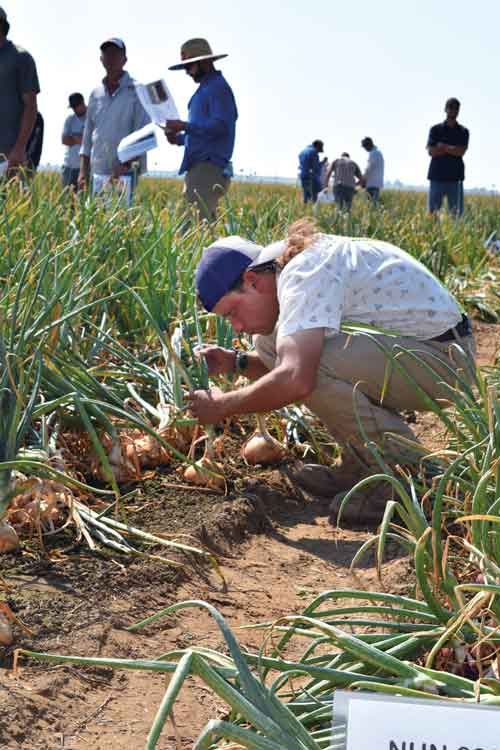
To decide if it’s justified economically to try to manage the disease with fungicide applications, growers should consider the factors that increase the risk of powdery mildew, du Toit said, including weather conditions, irrigation, cultivar, and pesticide usage. Growers should also consider how much longer the crop will be growing to assess the potential impact on bulb size and yield, as well as whether they are making any late-season fungicide applications to control other diseases such as Botrytis neck rot or black mold, as the products used for these are usually combinations of FRAC groups 7 and 11 that also help control or prevent the spread of powdery mildew.
In a subsequent report at the field day, du Toit spoke about black mold, which was also favored by the warm weather conditions in the Columbia Basin this August. Black mold began appearing in area onion fields in late August, and researchers are anticipating it could be a problem this year in storage. Infections start in the field, but often remain latent, so the disease may not be discovered until harvest or in storage.