
|
Click to listen to this article
|
By Leonardo Salgado, Graduate Research Assistant, Department of Entomology, Cornell University
The onion maggot (Delia antiqua) and seedcorn maggot (Delia platura) are among the most problematic insect pests in onions early in the season. Heavy infestations can reduce plant stands by up to 100% if not managed.
The onion maggot has three generations annually, with third-generation larvae overwintering in the soil as pupae. Flies emerge from pupae in late April or May, mate, and lay eggs at the soil base of onion plants. The onion maggot’s life cycle ranges from 37 to over 60 days, including three instars and a pupal stage.
The seedcorn maggot has three to five generations per year, but the initial generations tend to be more numerous and problematic during spring. It lays eggs in decaying organic matter. The seedcorn maggot’s lifecycle is notably shorter, lasting from 19 to 36 days.
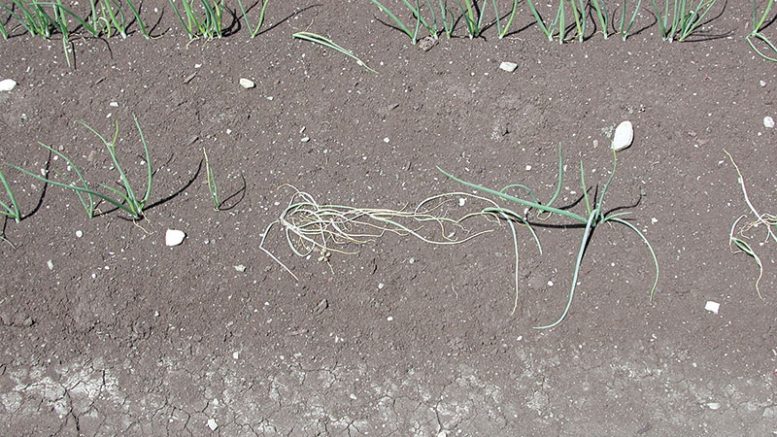
Young onion seedlings are especially vulnerable to first-generation larvae of both these insects because onion plants are more susceptible at an early stage. The onion maggot and the seedcorn maggot have different life histories. The onion maggot is a specialist that feeds only on plants in the onion family, such as onion, garlic, leek and chives. Leek, chive and garlic are less preferred by onion maggot than onion. In contrast, the seedcorn maggot is a generalist that feeds on a wide variety of crops such as beans, peas, corn, soybean, cucumber, melon, potato in addition to all of the crops listed above in the onion family. Both pests attack allium crops throughout the northern onion production areas in the U.S. and worldwide, but differ in abundance and pest status within each region. Larvae feed on the below-ground parts of the onion plant, which can kill the plant or render it unmarketable.
There is no curative treatment for the onion maggot and seedcorn maggot because once damage occurs, nothing can be done; therefore, management relies on preventive tactics. Maggot management is achieved through chemical, biological and cultural control practices. Some of these management practices are not economically practical in commercial-scale onion production but could be effective on small diversified farms.
Chemical Control
Control of the maggot complex (Diptera: Anthomyiidae) in onions is mainly achieved using seed treatments and transplant tray drenches in transplanted onions.
Foliar sprays have been used to target adult flies before oviposition, but this tactic is not effective because flies disperse and avoid insecticide exposure.
To control maggots, various insecticide seed treatments can be used. These include spinosad, a natural substance derived from a soil bacterium that serves as an insecticide for maggots; cyromazine, an insect growth regulator used to control fly larvae; and three neonicotinoids: thiamethoxam, clothianidin and imidacloprid, which are synthetic insecticides designed to mimic nicotine, a naturally plant molecule found in tobacco. Additionally, the effectiveness of an insecticide seed treatment may vary depending on the local prevalence of onion maggots and seedcorn maggots.
Any time you use a pesticide, you must read and follow the label directions and comply with all applicable laws and regulations related to pesticide use. Also, be sure that any pesticide used is approved for use in your country and state/province.
Biological Control
Around 100 species of beetles in the rove beetle (Staphylinidae) and ground beetle (Carabidae) families are generalist predators of eggs and larvae of fly adults.
There are also organisms called “nematodes” that are microscopic, worm-like animals that can infect maggots in onions and are commercially available. Some species may be compatible with soil-applied insecticides, but others are not. Soil conditions likely impact the performance of nematodes.
Finally, three groups of fungi, (Metarhizium spp., Beauveria bassiana and Entomophthora muscae,) are responsible for infecting and killing maggots in onions. However, fungal isolates tend to cause less mortality of larvae than adults. All are commercially available. An antagonistic effect is likely between entomopathogenic fungi and fungicides used to manage onion plant diseases.
Now, based on all this information, use the clues to complete the crossword puzzle.

ACROSS
2. A natural substance derived from a soil bacterium that can be used as an insecticide for maggots
4. A cultural control practice that can reduce maggot risk if new fields are over a mile from old ones
7. Microscopic creatures that look like worms, such as Steinernema feltiae, that can be used for the biological control of maggots
8. Rove _____ are generalist predators of maggot eggs and larvae
9. A biological control method where organisms like Beauveria bassiana infect and kill maggots is called entomopathogenic ____________
11. A generalist maggot species that is a pest on a wide variety of crops such as beans, peas, corn, soybeans, cucumber, melon, potato and onions
DOWN
1. A vegetable crop often attacked by maggots
3. Applying a protective chemical to seeds before planting
5. A specialist maggot species that feeds only on plants like onion, garlic, leek and chives
6. The life stage in which third-generation onion maggots overwinter in the soil
10. A chemical substance used to kill insects
12. An insect growth regulator used to control fly larvae