|
Click to listen to this article
|
Managing Bacterial Bulb Rot is All About the Neck of the Onion
Story and photos by Christy Hoepting, CCE Cornell Vegetable Program
The “Stop the Rot” project just wrapped up in August after six “rotten” years. It was an ambitious project involving 24 scientists from across the country who set out to research the complete system of bacterial diseases of onion to develop practical, economically sound strategies for pathogen detection and management that will improve profitability and sustainability of onion production.
Over these years, we sure did talk a lot about rot. And one thing that kept coming up was the neck part of the onion plant. Whether it was a tight neck or a soft neck, a thin neck or a thick neck, an exposed neck or a protected neck, a green neck or a dry neck, or a long neck or a short neck, focusing on the neck part of the onion plant proved to be central to managing bacterial onion bulb rot.
Managing Bacterial Diseases of Onion
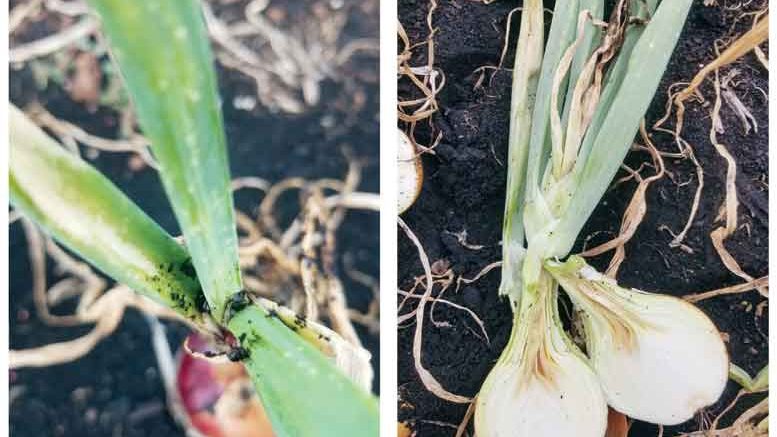
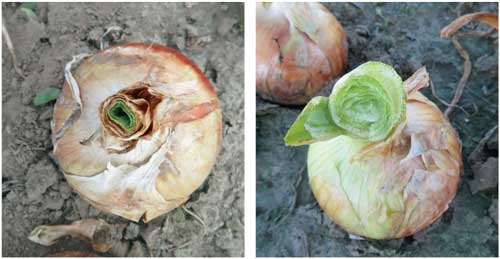
Soilborne bacterial pathogens are splash-dispersed onto onion plants where they usually infect plants in the neck region. If there is moisture in the neck, the pathogen can multiply in the neck tissue and move down the neck into the bulb (Fig. 1).
Because most bacterial pathogens of onions are “neck dwellers,” their location makes it difficult for foliar applications of bactericides with contact activity to be effective as the bacteria are protected in the neck. Products with contact activity, including copper bactericides, sanitizers and biological control products, failed to control bulb rot in nine Stop the Rot field trials in California, Colorado, New York and Washington.
Georgia was the only place where foliar applications of copper bactericides proved effective, providing 77-88% control. Stop the Rot scientists theorized that bactericides were effective in Georgia because the dominant bacterial pathogens in that winter area of production are “leaf dwellers” located where contact foliar sprays can contact the bacteria. “Leaf-dwelling” Pseudomonas spp. and Pantoea spp. dominated in Georgia onion fields surveyed during the cooler winter months, while in all other major onion growing regions “neck-dwelling” Pantoea spp. and Burkholderia spp. were dominant during the hotter summer months when onions are grown.
However, subsequent investigation indicated the most likely reason copper-based bactericides have been ineffective in most regions of onion production is that many of the bacteria in these regions are resistant to copper. Stop the Rot researchers found that 50% of the strains of Pantoea agglomerans from Washington and California, and 90% of the strains of Burkholderia spp. from New York and Pennsylvania for which their DNA was sequenced, have genes that confer resistance to copper. This was confirmed by testing bacterial strains on agar media amended with different concentrations of copper.
Except in Georgia, the Stop the Rot team does not recommend foliar sprays of copper bactericides, sanitizers or biological control products to manage bacterial diseases of onion.
Considering Onion Growth Stage and Susceptibility
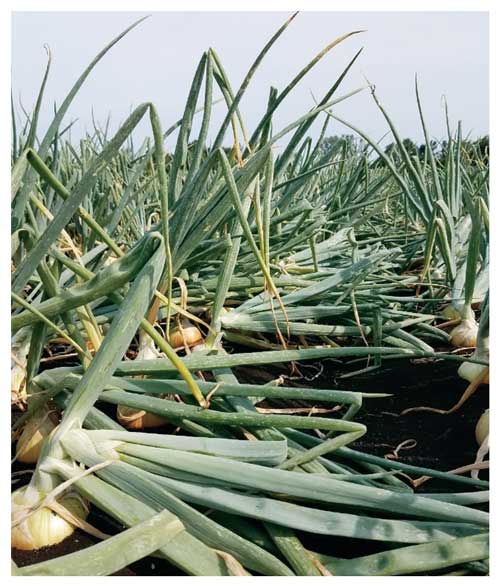
The onion growth stage most susceptible to infection by bacterial pathogens that leads to bulb rot is when the necks are soft, i.e., after the plants reach maximum neck size until the necks have dried (Fig. 2). When onion necks have reached full size and are soft, water can splash into the upright tops, creating favorable conditions for bacterial infection.Furthermore, the dense canopy at this stage means poor air movement between plants, creating a moist microclimate favorable for bacterial disease development.
During the “tops down” stage (lodging), onion neck tissue is dying and, thus, no longer has resistance to infection by bacterial pathogens.Stop the Rot research trials in Washington showed that bulb rot progressively increased for every week that irrigation was continued after 5% lodging. Consequently, the recommendation is to stop irrigation no later than 50% lodging, which can reduce bacterial bulb rot by up to 50% compared to continuing irrigation through 90% lodging. Stopping irrigation sooner can further reduce bulb rot but also may reduce yield.
In regions of onion production more at the mercy of rains, such as New York, if Mother Nature is kind, she will not deliver “rot rain” at maximum neck size through 50% lodging.
Rolling Foliage Prior to Pulling/Undercutting
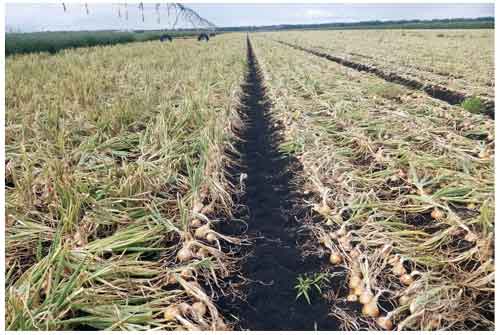
If “rot rain” is in the forecast when at least 80% of the onions in a field have soft necks and the foliage still has some green color (moisture), the field may be rolled gently to lay down any upright plants so that rain cannot splash infested soil into the neck (Fig. 3).
Stop the Rot studies in New York showed that rolled onions had 35-57% less bulb rot than non-rolled onions. Rolling onions is especially effective when onion plants are “dying standing up,” which happens when thrips or disease has ravaged the foliage to the extent that it does not have enough weight to lodge properly.
Rolling onions is a way of preventing new bacterial infections from occurring. For plants that are infected but the bacterial infection has not yet moved down the neck into the bulb, protecting open necks from collecting water by rolling the tops could avoid the favorable conditions that accelerate progression of bacterial infection into the bulb.
Timing Topping
Green neck tissue contains moisture, which is critical for the bacteria to multiply (reproduce) and move down the neck into the bulb. Bacteria cannot reproduce or move in dry neck tissue. Topping/harvesting when neck tissue is green (moist) creates a wound that is an “open door” for bacterial infection. The greener the neck tissue at topping/harvesting, the greater the risk of bulb rot. A Stop the Rot study in Washington showed that topping/harvesting onions when the foliage had only 5% green tissue and the necks contained 60% moisture significantly reduced bub rot by 65-89% compared to topping/harvesting onions with 90% green foliage and 90% moisture in the neck (Fig. 4).
Winning the “Rot Race”
Ways to win the “rot race” include:
- Pull/undercut onions to speed up drying of onion foliage. Ideally, Mother Nature will be kind and deliver warm sunny weather with a light breeze to dry onion foliage rapidly vs. days of rainy weather. Keep in mind, however, pulling/undercutting onions too early can reduce bulb size and yield.
- Avoid late applications of nitrogen fertilizer (after initiation of bulbing). This promotes vegetative growth and delays maturity, resulting in thick-necked onions that take longer to dry and that dry later in the season when field conditions are less favorable for drying.
- If neck tissue is green, top onions to leave at least 2-3 inches of neck length. This increases the distance that a bacterial infection at the tip of the topped neck must travel to get to the bulb, which “buys time” for the neck to dry down and become impassable for the bacterial infection to spread into the bulb.Georgia studies showed that leaving necks 2-3 inches long when onions were topped with green necks reduced bulb rot by 36-66% compared to onions that were topped with a neck length of 0-1 inch.
- Rolling onions to prevent water from pooling in the necks can make conditions less favorable for bacterial infection to spread into the bulb.
- When onions are harvested with >5% green foliage and >60% neck moisture, they can be cured with heated forced air in a building. Since new bacterial infections can occur at the tips of green necks after topping onions, leaving a 2- to 3-inch-long neck and using postharvest curing can quickly dry down the neck tissue to prevent bacterial infections from entering the bulbs. Note, only healthy onions should be cured postharvest with heated air, not those already infected in the necks with bacteria because the warm/hot temperatures used for postharvest curing are favorable for bacteria and accelerate movement of bacterial infection from the neck into the bulb.
- Multiple years of trials in Washington and Colorado showed that applying disinfectants like ozone or hydrogen peroxide to onion bulbs in storage does not prevent any latent infections in the bulbs from developing in storage because these products cannot penetrate the outer, dry wrapper scales to the site of infection in the necks or bulbs.Once bacterial infection has spread into the bulb, there is nothing that can be done.