
By Julia Scicluna, Michael Kooy, Bruce D. Gossen, Mary Ruth McDonald, University of Guelph
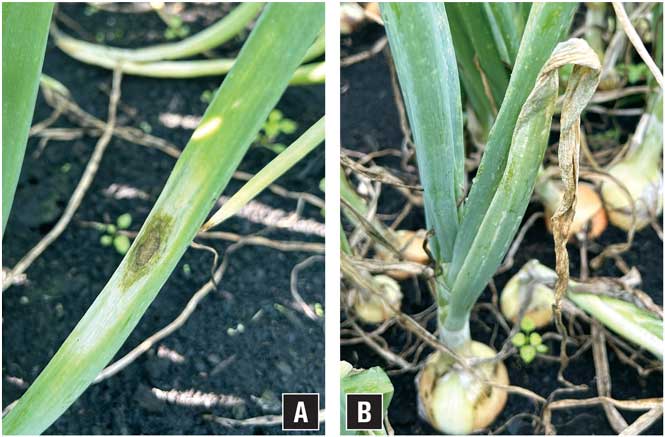
Stemphylium leaf blight (SLB) was first reported in the Holland Marsh, Ontario, Canada, in 2008. It causes lesions and leaf dieback progressing from the tip (Fig. 1). SLB can reduce quality and yield, but major losses are uncommon in Ontario. In most years, disease severity increases after the bulbs have already formed. However, severe leaf dieback can interfere with the uptake of sprout inhibitors such as Royal MH. Onion plants need five to eight green leaves for uptake of Royal MH. When leaves dieback early due to SLB, sprouting in storage can increase.
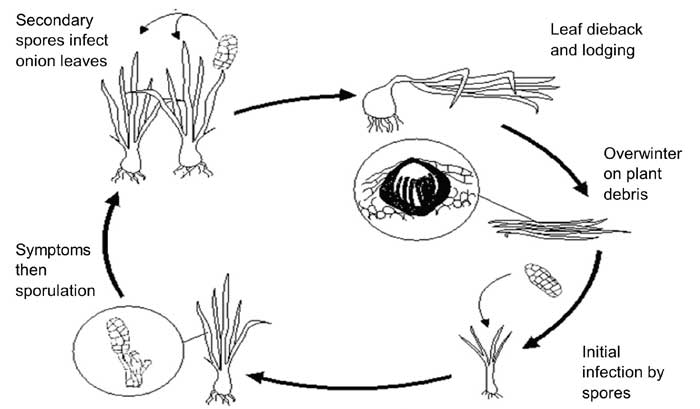
The pathogen, Stemphylium vesicarium, starts producing spores in the spring. The spores initially infect young onion plants at the third to fourth true leaf stage. New spores are produced on infected leaves and spread the disease to healthy plants, which causes many cycles of infection to occur during the growing season. The pathogen survives over winter on infected onion leaves left in the field and other overwintering plant material (Fig. 2).
No yellow onion cultivars have strong resistance to SLB. Sanitation to remove infected crop residue from fields has a limited impact because spores can blow in from nearby fields. The pathogen can also infect other crops such as garlic, asparagus and pear, as well as many weeds found in and around onion fields. Fungicides are registered for management of SLB, but their effectiveness has been inconsistent and fungicide resistance has developed rapidly.
Fungicide Efficacy
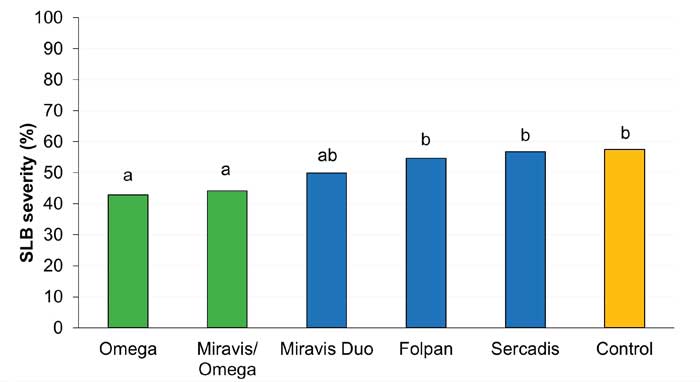
The effectiveness of many common fungicides has decreased over time, likely because of fungicide resistance. In the most recent trials in 2024 and 2025, suppression of SLB was limited. The most effective fungicides were Omega (or Allegro; fluazinam, Group 29) and Omega alternated with Miravis Duo (pydiflumetofen + difenoconazole, Group 7/3) (Fig. 3). Omega is at low risk for developing resistance and can be used in rotation with Group 7 products.
Fungicide Resistance
Fungicide resistance has become a major issue for managing SLB. Products that were once effective no longer reduce SLB severity. High levels of resistance to Quadris Top (azoxystrobin + difenoconazole, Group 11/3) and Luna Tranquility (fluopyram + pyrimethanil, Group 7/9) have been detected since 2018. These fungicides are no longer recommended for SLB in the Holland Marsh. Since 2021, moderate resistance has also been identified for Sercadis and Merivon (fluxapyroxad + pyraclostrobin, Group 7/11).
To continue monitoring resistance, a new molecular method was developed to detect resistance to Group 7 and Group 11 fungicides. All samples recently collected in the Holland Marsh had high resistance to Group 11, and many were also resistant to Group 7 fungicides.
Widespread fungicide resistance has also been reported in onion production regions of New York state. These results demonstrate how quickly resistance can develop, especially when onion fields are close together or onions are grown in short rotations.
Fungicide Timing Using Disease Forecasting Models
Disease forecasting models can help improve fungicide timing. Spraying fungicides only when disease risk is high can reduce unneeded sprays and help slow the development of resistance. When disease is low, fungicide applications may not be needed at all.
Forecasting models for SLB have been tested in the Holland Marsh for the past 10 years. Developing an effective model has been challenging because most fungicides are not effective. The TOMcast model, originally developed for foliar diseases of tomato, has shown some success but often triggers more fungicide sprays than necessary. To solve this problem, a new model called STEMcast was developed based on weather that favors SLB.
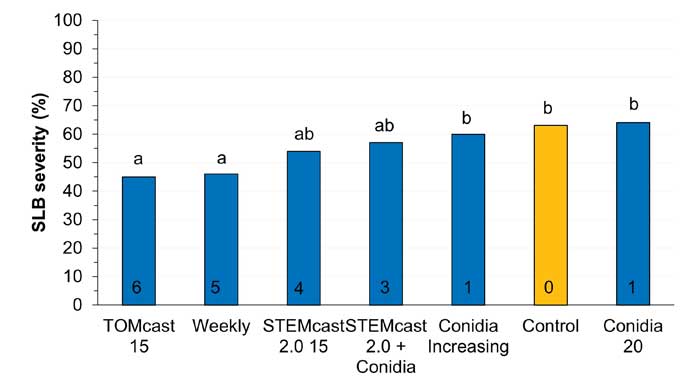
In 2024, weekly sprays and the TOMcast model reduced SLB severity, but TOMcast triggered even more sprays than the calendar schedule. The STEMcast model did not reduce disease and still needed improvement (Fig. 4).
Greenhouse experiments were conducted to get more information on the ideal conditions for SLB. Conditions for SLB development were identified as leaf wetness longer than 12 hours and temperatures between 64 and 73 degrees Fahrenheit (18–23 degrees Celsius). This information was used to update the model, now called STEMcast 3.0.
In 2025, field conditions were hot and dry, and disease was low. Under these conditions, STEMcast 3.0 did not trigger any fungicide sprays, which was appropriate for the low disease risk that season. There were no differences in yield, which also indicated that no fungicides were needed that year. This is a step in the right direction, but the model still needs to be tested in years with higher disease pressure.
Conclusions
Stemphylium leaf blight is a problem for growers in Ontario and other regions. The main challenges are limited fungicide options and the rapid development of fungicide resistance. Omega provides some suppression of the disease and has a low risk of resistance development, but more fungicides with different modes of action are needed. The STEMcast 3.0 forecasting model shows promise for improving fungicide timing and reducing unnecessary sprays.
Managing SLB is difficult and requires an integrated pest management approach. Ongoing research is focused on evaluating new fungicides for SLB management, improving forecasting models, identifying onion cultivars with lower susceptibility to SLB and monitoring fungicide resistance.
Annual reports can be found online at bradford-crops.uoguelph.ca/publications/cultivar-trial-and-research-reports.
Authors’ note: This research was funded by the California Garlic and Onion Research Advisory Board, the Ontario Agri-Food Innovation Alliance, the Fresh Vegetable Growers of Ontario and the Bradford Cooperative Storage Ltd.