
|
Click to listen to this article
|
By Marcelo Dimase, University of Idaho
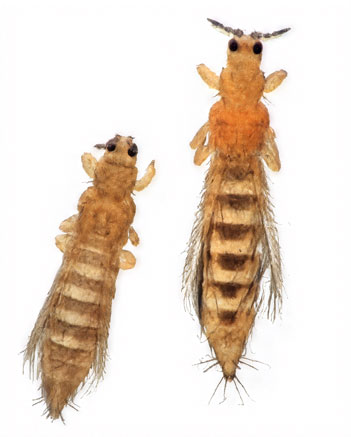
Thrips remain one of the most economically damaging insect pests of onion in the western United States, but growers face an increasingly complex challenge: the pest populations they manage may not all be the same species. For many years, onion thrips (Thrips tabaci) have been considered the primary threat in commercial onion fields in Idaho, Oregon and Washington. However, new observations suggest that western flower thrips (Frankliniella occidentalis) can also be present in meaningful numbers at certain times of the season. These species are difficult to distinguish in the field, yet they differ in their biology and how they respond to insecticides. As growers report inconsistent performance of familiar products, the need to understand species composition has become essential for effective management and for preventing resistance from becoming more widespread.
Understanding Why Species Composition Matters
The balance between onion thrips and western flower thrips is more than an academic question. It is directly related to how well insecticides perform. Onion thrips typically dominate early in the season, but the proportion of western flower thrips may increase as temperatures rise and spray intervals tighten. Because these two species vary in their susceptibility to commonly used insecticides, even a modest shift in their relative abundance can influence the success of a spray program. When a grower sprays a product expecting to target onion thrips but the field is dominated by western flower thrips, the outcome may appear to be resistance even when the issue is species composition. Without knowing which species are present, management becomes more uncertain and costly.
Building a Regional Picture of Thrips Species
To address this challenge, Marcelo Dimase from the University of Idaho Parma Research and Extension Center is leading a multi-state effort including Washington, Oregon, Idaho, Utah and New Mexico to conduct a coordinated survey of thrips species composition in major onion-growing regions. Beginning in late spring 2026 and continuing through the summer, thrips will be collected weekly from onion fields in these regions. Each sample will be processed so that adults and larvae can be identified using morphological keys.
This effort will provide the first region-wide baseline of how thrips species composition changes over time and among farms with different insecticide programs. Early patterns are expected to indicate that onion thrips remain prevalent across most fields, but western flower thrips can appear later in the season and may be more abundant in certain locations. Understanding these patterns will allow growers to anticipate when species shifts are likely and adjust management accordingly.
Assessing Insecticide Susceptibility Across Species
Species identification alone is not enough. Growers also need to know how each species responds to the insecticides commonly used in onion production. To complement the regional surveys, Dimase and colleagues will conduct insecticide bioassays using thrips collected directly from growers’ fields and comparing them to long-term laboratory colonies with no history of insecticide exposure. These bioassays are performed using maximum labeled field rates of products such as abamectin, spinetoram, methomyl and lambda-cyhalothrin. The goal is to detect early signs of reduced susceptibility and to determine whether onion thrips and western flower thrips differ in their responses. This is especially relevant as growers continue to report variability in the performance of key insecticides, particularly in areas with heavy spray pressure.
Connecting Results to Field-Level Decisions
The combination of species composition data and insecticide susceptibility information provides a much clearer picture of what is happening in growers’ fields. If a field is dominated by onion thrips but shows signs of declining susceptibility to a particular product, resistance is likely the cause. If western flower thrips dominate later in the season and a product performs poorly, the issue may be species-specific reduced susceptibility rather than true resistance. These distinctions matter because they help guide decisions about product selection, spray intervals and IRAC-group rotation. They also help prevent unnecessary applications that may further intensify resistance pressure.
Engaging Growers Through Workshops, Industry Meetings
Our team will share results from both the species composition surveys and the insecticide bioassays with growers through workshops and commodity meetings in the participating regions. These sessions will focus on how species composition shifted during the season, how thrips populations from different regions responded to commonly used insecticides and what these patterns mean for designing more effective rotation programs. These workshops will also encourage dialogue with growers, whose observations help refine recommendations and identify regions where additional monitoring may be needed.
Looking Toward Long-Term Resistance Management
By establishing a clear baseline of species composition and susceptibility, the research team is laying the foundation for predictive models, improved economic thresholds and decision support tools tailored to specific regions. Ultimately, the goal is to help growers maintain the effectiveness of the limited insecticides available for thrips control and to safeguard production against increasing pest pressure.
If you are interested in collaborating or receiving updates as results become available, contact Dimase at marcelod@uidaho.edu.