
By Kevin Vander Kooi, Geoff Farintosh, Ifesinachi Ezeh and Mary Ruth McDonald, University of Guelph
Labor shortages, rising production costs, limited herbicide options and increasing herbicide resistance have led growers to explore alternative approaches to weed management in onions, such as agricultural robots. Robotic and autonomous field technologies promise greater precision, reduced labor dependency and improved efficiency. Robots are being evaluated as practical tools to support sustainable crop production rather than as replacements for existing practices.
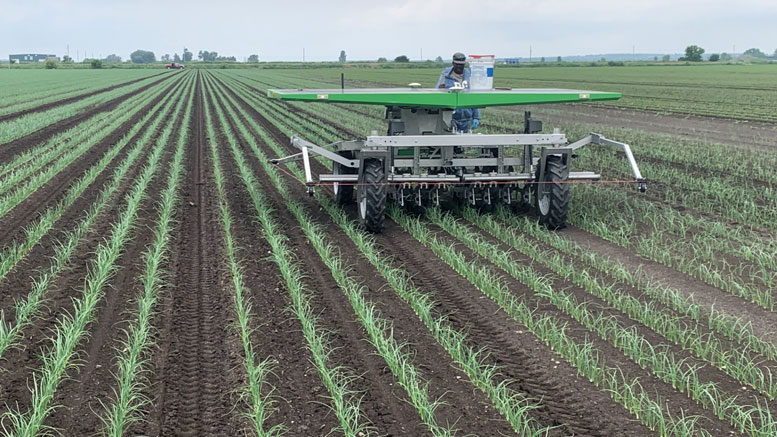
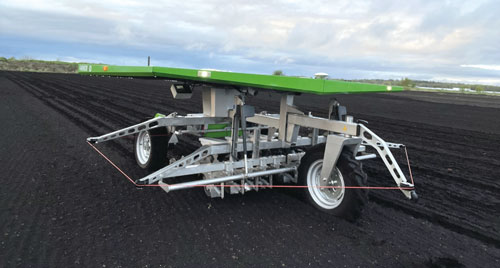
The FarmDroid FD20 robotic system (Fig. 1, Fig. 3) was evaluated for onion seeding and in-row mechanical weeding in commercial fields in the Holland Marsh area of Ontario, Canada, over three growing seasons. The trials were conducted under real production conditions to determine how the technology performs on a working farm. Research focused on stand establishment, weed suppression, yield and overall operation, compared with the grower’s standard production practices. The goal was to understand if the robot could realistically fit into commercial onion production and how it could contribute to integrated weed management.
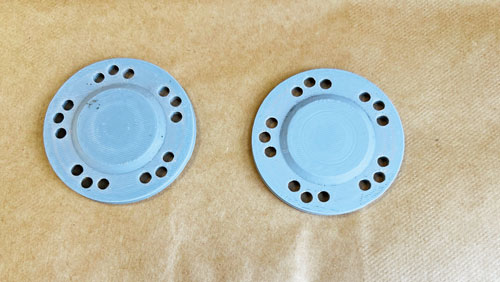
The Farm Droid FD20 seeding system ensures precise seed placement. A 3D-printed seed disc (Fig. 2) meters the exact number of seeds, and the robot places them in the soil. The FD20 geotags each seed during planting and creates a digital map that guides the in-row weeding tools, allowing the robot to know exactly where each onion plant is located. This allows accurate cultivation while minimizing the risk of crop injury. This level of precision limits the operating speed compared with conventional equipment. As a result, the first year of seeding with the robot was performed at slower speeds. This trade-off reduced field efficiency initially, but it provided the precision necessary for automated weeding and demonstrated that the robot could seed with accuracy.
-AMAZONPOLLY-ONLYWORDS-START-
-AMAZONPOLLY-ONLYWORDS-END-
Field Performance, Practical Results
In 2023, onions were seeded using four single rows per bed, with seeds spaced 3.4 cm apart within each row, at an operating speed of 225 meters per hour. This configuration differed from the conventional system, which used four twin rows per bed, yet the FD20 achieved comparable plant stands. The FD20 uses a seed valve system to geotag each seed. Because of the close seed spacing, operating speed was slow to provide enough time for the valve to open and close properly for each seed. While this ensured accurate placement, there was a need to adjust seed spacing to improve speed while maintaining desirable plant stands.
Based on the 2023 results, the seeding configuration was adjusted in 2024 and 2025 to increase operating speed and better reflect typical onion production practices. Onions were planted in four rows per bed using clusters of three seeds spaced 9.5 cm apart within the row, using a 3D-printed disc designed for this spacing (Fig.2). The operating speed could increase to 550 meters per hour. This clustered arrangement resembled the spacing for onion transplants and allowed accurate seed placement while maintaining geotagging. Plant stands achieved with this configuration of the FD20 were comparable to those from conventional tractor seeding.
The FD20 is capable of performing precise in-row mechanical weeding shortly after crop emergence. The system accurately avoided onion plants while cutting or burying weeds growing between rows. Weed suppression improved when multiple cultivation passes were made and the original wire tines were replaced with steel V-shaped knives. However, weeds located directly within the onion row were more difficult to remove without risking crop injury. Field conditions also influenced performance; uneven surfaces reduced weed control. This showed that robotic weeding is most effective when integrated with herbicide programs and supported by good field preparation.
Yield comparisons across the trials were encouraging. In several seasons, onions seeded and weeded by the FD20 produced yields comparable to conventional tractor-based production. In other trials, yields from the FarmDroid-managed field was similar to conventional but slightly lower than a different robot, likely due to stand variability and field conditions rather than limitations of the FarmDroid itself. Size distribution of harvested onions was generally similar between robotic and conventional systems.
-AMAZONPOLLY-ONLYWORDS-START-
-AMAZONPOLLY-ONLYWORDS-END-
Conclusions
For growers interested in automation, the FarmDroid FD20 represents a practical entry point into robotic field operations, particularly where labor efficiency and precision weeding are priorities. Across multiple seasons, robotic seeding produced onion stands comparable to conventional planting, while GPS-guided mechanical cultivation effectively reduced between-row weed pressure. Although in-row weeds still require control and yields showed some seasonal variability, overall crop quality was high.
The trials demonstrated that robotic onion production is technically feasible under commercial muck soil conditions when paired with proper calibration and good field preparation. Rather than replacing conventional practices outright, the FD20 functions best as a precision seeding and weeding tool that complements existing management strategies. Continued refinement of seeding configurations and cultivation tools is expected to further improve efficiency and consistency, supporting the growing role of robotics in commercial vegetable production.
Authors’ note: Funding for this project was provided by the Fresh Vegetable Growers of Ontario, Haggerty AgRobotics Inc., the Ontario Agri-Food Innovation Alliance and Innovation Farms powered by AgExpert.